Indigenous Peoples Caucus Statement at COP22 APA Session

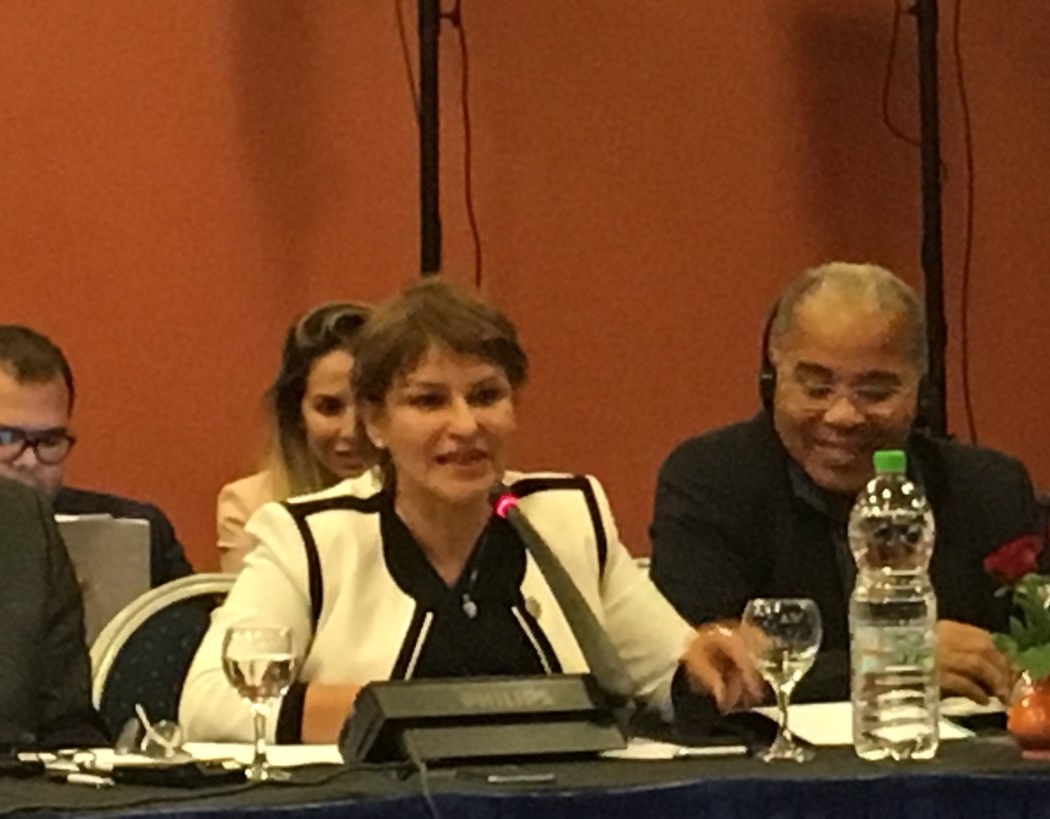
Jannie Staffansson reads the Indigenous Peoples Caucus statement at the APA session of COP22 in Marrakech, Morocco, November 7, 2016   

Jannie Staffansson reads the Indigenous Peoples Caucus statement at the APA session of COP22 in Marrakech, Morocco, November 7, 2016   

On Monday, Jannie Staffansson (Sami) delivered the  Indigenous Peoples Caucus Statement at the #UNFCCC Ad Hoc Working Group on the Paris Agreement (APA) opening Plenary. The statement raised recommendations for the future implementation of the Paris Agreement, as well as called upon the countries who signed onto the Geneva Pledge on Human Rights and Climate Change to establish a Working Group or a program on Human Rights and Climate Change within the UNFCCC process. The statement made at the APA session was one of four presented by the Indigenous Peoples Caucus on Monday at COP22 in Marrakech, Morocco.  #IIPFCC  #Saamicouncil #IndigenousCOP22

Statement of the International Indigenous Peoples Forum on Climate Change (IIPFCC) to the Ad Hoc Working Group for the Paris Agreement (APA), November 7, 2016, Marrakech, Morocco

English |  Español  |  Français  | Русский

El día de hoy dio inicio la Conferencia sobre Cambio Climático

El día de hoy dio inicio la Conferencia sobre Cambio Climático de la Organización de las Naciones Unidas, la COP 22, en la ciudad de Marrakech, Marruecos, y que tiene como uno de sus propósitos la implementación de los "Acuerdos de París", que establecen las bases normativas para hacer frente y resolver el grave desafío que supone para toda la humanidad la cuestión del cambio climático.

Como es costumbre en esta Conferencia, hoy por la mañana se reunió el Cónclave de los Pueblos Indígenas, a fin de compartir información sobre las actividades a desarrollarse y repartir las tareas que cada uno de los presentes debemos asumir, a fin de plantear y defender las preocupaciones y exigencias que tienen los pueblos indígenas con relación al cambio climático.

En este contexto es importante destacar que con relación a los pueblos indígenas, se desarrollaron dos importantes actividades paralelas:

Por un lado un Panel organizado por la UNESCO en la que se abordó el tema de los "Conocimientos de los Pueblos Indígenas", que es una cuestión que se establece en el numeral 5 del artículo 7 de los Acuerdos de París que afirma: "Las partes reconocen que la labor de adaptación debería llevarse a cabo mediante un enfoque que deje el control en manos de los países, responda a las cuestiones de género y sea participativo y del todo transparente, tomando en consideración a los grupos, comunidades y ecosistemas vulnerables, y que dicha labor debería basarse e inspirarse en la mejor información científica disponible y, cuando corresponda, en los conocimientos tradicionales, los conocimientos de los pueblos indígenas y los sistemas de conocimientos locales, con miras a integrar la adaptación en las políticas y medidas socioeconómicas y ambientales pertinentes, cuando sea el caso."

Por el otro, Representantes Indígenas de diversos países de África, hicieron una serie de presentaciones sobre sus experiencias de trabajo en el marco del Mecanismo de donaciones específico para los pueblos indígenas y las comunidades locales (MDE), en sus esfuerzos por reducir la deforestación y degradación de los bosques. Una serie de experiencias que habrá que analizar teniendo en cuenta sus resultados.

Para mañana se tiene previsto la inauguración del Pabellón de los Pueblos. Esperamos el día de mañana poder informar sobre este importante esfuerzo que se hace en esta COP 22 para dar visibilidad al valioso aporte y contribución de los pueblos indígenas en todo el mundo a fin de resolver los desafíos adversos del cambio climático.

Indigenous Peoples Caucus begins daily meetings at COP22

The first of two weeks of daily meetings for the Indigenous Peoples Caucus was held on Monday, 7 November 2016 from 9-10am at the COP22 conference site in Marrakech, Morocco. During the meeting, strategies were set for the engagement of Indigenous Peoples from seven geo-political regions at COP22 throughout the day and for the week. On Monday, the #IIPFCC delivered four statements, two were read in plenary sessions and two were submitted to the UNFCCC Secretariat. All the statements from the Indigenous Peoples Caucus are now located at the UNFCC website and will be made available here shortly. It is noteworthy that following very positive verbal exchanges during a meeting between Indigenous Peoples and several State Parties on Sunday, not one state mentioned #indigenous Peoples rights during any of their opening statements on Monday.    

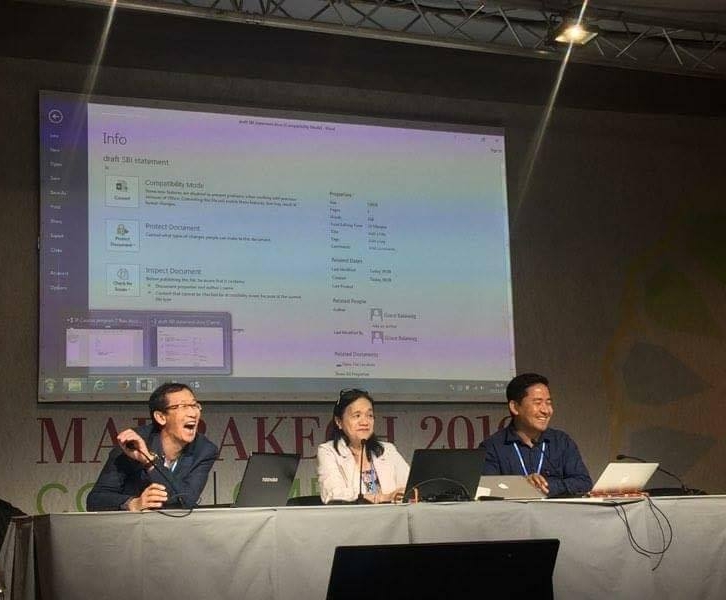
Rodion Sulyandziga; Grace Balawag; and Lhakpa Nuri Goparma Sherpa lead the spirited exchanged at the morning Indigenous Peoples Caucus meeting on Monday at COP22. Photo Credit: India Logan-Riley 

Rodion Sulyandziga; Grace Balawag; and Lhakpa Nuri Goparma Sherpa lead the spirited exchanged at the morning Indigenous Peoples Caucus meeting on Monday at COP22. Photo Credit: India Logan-Riley 

Inició el Cónclave de los Pueblos Indígenas del COP22

Por Adelfo Regino 

El día de hoy en la ciudad de Marrakech, Marruecos, que en lengua Amazigh significa "Tierra de Dios", ha dado inició el Cónclave de los Pueblos Indígenas en el marco de la Conferencia de las Naciones Unidas sobre el Cambio Climático COP 22, que se llevará a cabo en esta emblemática ciudad del 07 al 18 de noviembre del año en curso.

Al inicio de este Cónclave se ha rendido un sentido homenaje al Dr. Rodolfo Stavenhagen por toda su labor a favor de los pueblos indígenas en todo el mundo, en particular por su valioso trabajo como primer Relator de los Pueblos Indígenas de la ONU. El Cónclave Indígena ha guardado un minuto de silencio y ha enviado sus condolencias a su familia, por su lamentable fallecimiento.

El Cónclave tiene una Agenda de Trabajo que se desahogara durante todo el día, con el propósito de tomar las decisiones más importantes con relación a la participación de los pueblos indígenas en la COP 22, en el que se tomarán decisiones trascendentales para la Implementación de los "Acuerdos de París" en el que será de vital importancia la voz y decisión de los pueblos indígenas.

Con dolor en nuestros corazones y pensamientos por la partida de Rodolfo, hoy damos inicio a una nueva jornada de lucha en la implementación de los derechos de los pueblos indígenas en el contexto de las negociaciones sobre el cambio climático.

COP22 Conference Venue Information

The COP22 venue is at Bab Ighli is located approximately 10 minutes away from the Marrakech city centre and 10 minutes from Marrakech Airport. It consists of the main conference area, also known as the “Blue Zone”, and space for civil society and other participants also known as the “Green Zone”.

Registration

Registration is open from 5 November until Friday, 18 November 2016, from 8.00 a.m. to 7.00 p.m.  The acknowledgement letter of the participant’s confirmation, obtained through confirmation in the online registration system, and a valid passport or a nationally approved photo identification card should be presented to the registration staff in order to ensure the issuance of your badge.)

Daily Caucus:

IPs Caucus daily meeting will take place from 9.00 AM-10.00 AM at room Arabian at Blue zone

Banking

Opening days and hours of the office of Bank Al-Maghrib at the Bab Ighli conference site: From Monday, 7 November, to Friday, 18 November 2016, from 9.00 a.m. to 4 p.m.

Please note that the Bank office will be closed on Saturday, 12 November, and Sunday, 13 November 2016. The Bank office is located in the Services area


COP 22 BUS shuttle map

DOCIP Technical secretariat at COP22

We have the pleasure to announce Docip’s presence at the COP22 meeting in Marrakesh, November 7 - 18, 2016.

You can find our technical secretariat in the Indigenous Peoples' and Communities' Pavilion, in the Green Zone. It will be open from 10:00am to 7:00pm.

Thanks to Docip's vast network of multilingual volunteers we offer the following free services to all Indigenous delegates attending the meeting:

▪ Translation to and from English, French, Spanish and Russian
▪ Interpretation on demand to and from English, French, Spanish and Russian for informal meetings and bilateral sessions, as well as regional caucus meetings
▪ Guidance for new participants
▪ Photocopies and other administrative tasks


In order to support the Indigenous delegates’ work, Docip offers them an office space equipped with:

▪ An office to use as workspace
▪ Computers and printers
▪ Internet connection
▪ Office supplies


For all questions please contact Karen Pfefferlikaren@docip.org - phone/whatsapp:+41 78 885 52 89 or Miguel Bettisectec-intern@docip.org 

COP 22 Bus Shuttle

Shuttle Service to COP22 site (Bab Ighli)

Shuttle service in the city of Marrakech will be provided free of charge for all participants (on presentation of badge) from November 5 to 18 from 6am to midnight, according to the following schedule:

– Peak hours (7am-10am and 6pm-8pm): shuttle every 15 minutes

– Off-peak hours (6am-7am; 10am-6pm and 8pm-midnight): shuttle every hou

Bus shuttle map

Indigenous Peoples Dialogue with UNFCCC States Parties

The Indigenous Peoples' dialogue with Parties to the UN Framework Convention on Climate Change (UNFCCC) took place on 5 Nov at Hotel Meridien in Marrakech from 2-5 pm. 

Indigenous Peoples Dialogue with UNFCCC States Parties

Indigenous Peoples Dialogue with UNFCCC States Parties

COP22 President Mr. Salaheddine Mezouar and Morocco Minister of Environment, Ms. Hakima El Haite addressed the representatives of Indigenous Peoples from seven geo-political regions attending the dialogue. On behalf of International Indigenous Peoples Forum on Climate Change (IIPFCC), Ms. Jannie Staffansson put forward the key demands of indigenous peoples for COP22.

COP22 President Mr. Salaheddine Mezouar 

Minister of Environment, Ms. Hakima El Haite

Minister of Environment, Ms. Hakima El Haite

The dialogue between Indigenous Peoples and States was interactive, constructive and set a good path for future dialogues with parties to the UNFCCC. Government representatives from France, Norway, Australia, Indonesia and New Zealand were present in the dialogue. 

Ms. Hindou Oumarou Ibrahim, the co-chair of Indigenous Peoples’ Caucus moderated the session. The IIPFCC will soon be distributing the Indigenous Peoples' political statement in abridged and longer versions in the coming days.

IPs caucus meeting and Pavilion at COP22


Greetings Sisters and Brothers,

We hope and believe that you are zipping up your bags and beginning your travels to Marrakesh, Morocco

We would like to update you all on the following:

  • The Global IPs caucus will takes place on 6 November at the Meridien Hotel, Avenue Mohammed VI from 9.00 AM to 6.00 PM
  • The official opening of indigenous peoples and local communities pavilion will be on 8 November from 11:00 AM to 12:30 PM at Green Zone.
  • IPs Caucus daily meeting will take place from 9.00 AM-10.00 AM at room Arabian at Blue zone

We look forward to impacting the Climate Change processes and implementation of the Paris Agreement

COP 22 Info Brief

COP 22 Info Brief: Useful websites and links

As we look forward to hosting your participation in COP 22 ( Marrakesh 7-18, Nov 2016, we wish to link you to some useful resources and websites for respective information.

Official COP 22 website is http://www.cop22.ma/ Please interact and note the following very informative sections:

  • Useful information about Morocco: here
  • Traveling to the Kingdom of Morocco: here
  • Map of the COP Space: below

Further, the following websites offer an overview of the respective Schedule of Negotiations and Side events in both Zones:

  • Blue Zone side events:  here... *Accreditation needed
  • Green Zone side events ( Civil Society Space): here

The Indigenous Peoples' and Communities' Pavilion will be located inside the Civil Societies Space (Green Zone). We will provide additional information on getting there.

North American Indigenous Peoples Climate Change Consultations Report Available

The International Indian Council (IITC) published a North American Indigenous Peoples Climate Change Consultations Report in March 2016. The report highlights a diverse range of input toward COP21 from Indigenous Peoples of North America including a summary of North American Indigenous Peoples activities leading up to and during the Paris Climate Summit. The results of a Climate Change Questionnaire developed by IITC and focusing on key issues, impacts and solutions for mitigation and adaptation including the role of Indigenous Peoples' traditional knowledge and practices. The questionnaire was distributed during the North American consultations and online in English and Spanish via various web sites and list serves. Exceeding the initial goal of two hundred, the IITC collected and complied two hundred and thirteen completed questionnaires including fifteen collected online.  

As a result of input received from elected and traditional leaders as well as representative organizations, responses were reported to represent the voices of approximately 318,000 North American Indigenous individuals. Respondents represented a diverse sample  of  Indigenous Peoples’ representatives including Tribal Leaders (elected and traditional), elders,  youth,  educators, rights advocates, community organizers, food producers, cultural/spiritual leaders, and professionals. The respondents represented voices from diverse geographical areas across North America and eco and food systems which included coastal/islands, forests, deserts, mountains, Arctic/sub arctic, plains, agricultural areas, rivers and river deltas, lakes, wetlands and highlands.        

North American Indigenous Peoples Climate Change Consultations Report Available Here

Calling all Indigenous Peoples, community-based organizations and grassroots groups!​​​​

The next UN Climate Conference (UNFCCC COP 22), taking place in November 2016 in Marrakech, Morocco, is being called the “COP of Action.” Now that the Paris Agreement on Climate Change is entering into force, world leaders are coming together to decide how to put this new global climate framework to work on the ground.

Here is where you come in! We invite you to make your voice heard at COP 22!

Research shows us that indigenous peoples’ and local communities’ solutions to climate change are some of the most innovative, most sustainable, and most effective.

Show the world that indigenous peoples and local community voices matter in climate action!

Your message will be incorporated into an interactive touch-screen world map that will be displayed at the “Indigenous Peoples' and Communities' Pavilion: Traditional Knowledge for Climate Action” during the entire duration of the COP 22 climate negotiations, from 7-18 November 2016. This Pavilion is a platform for indigenous peoples and local communities to have their traditional knowledge and solutions to climate change heard by government representatives, the media, partners and the global public.

Please share (in 100 words or less) your solution for climate action! 

Reflecting on Indigenous Peoples' Engagement in COP 21 and the Implications of the Paris Agreement

Reflecting on Indigenous Peoples' Engagement in COP 21 and the Implications of the Paris Agreement

On Wednesday 11 May 2016, during the United Nations Permanent Forum on Indigenous Issues (UNPFII), the United Nations Development Programme (UNDP) and the International Indigenous Peoples’ Forum on Climate Change (IIPFCC) co-hosted a side event to report on indigenous peoples’ participation in UNFCCC COP 21 and reflect on the outcomes and achievements of their advocacy and engagement. Panellists were welcomed by a full house and a number of viewers joining via live webcast.

Réflexion sur l'engagement des peuples autochtones dans la COP21 et sur les répercussions de l'Accord de Paris

Réflexion sur l'engagement des peuples autochtones dans la COP21 et sur les répercussions de l'Accord de Paris

Le mercredi 11 mai 2016, à l'occasion de l'Instance permanente sur les questions autochtones des Nations Unies (UNPFII), le Programme des Nations Unies pour le développement (PNUD) et le Forum international des peuples autochtones sur les changements climatiques (FIPACC) ont organisé ensemble une manifestation parallèle pour faire le bilan de la participation des peuples autochtones à la COP21 pour la CCNUCC et réfléchir aux conséquences de leur mobilisation. Les experts ont été accueillis par un public nombreux ainsi que par des internautes présents via une diffusion en direct sur le Web.

Reflexión de la participación de los pueblos indígenas en la COP y las implicaciones del acuerdo de París

Reflexión de la participación de los pueblos indígenas en la COP y las implicaciones del acuerdo de París

El miércoles 11 de mayo de 2016, durante el Foro Permanente de las Naciones Unidas para las Cuestiones Indígenas (UNPFII), el Programa de las Naciones Unidas para el Desarrollo (PNUD) y el Foro Internacional de Pueblos Indígenas Sobre Cambio Climático (FIPICC) organizaron un evento paralelo para relatar la participación de los pueblos indígenas en la CMNUCC COP 21 y reflexionar sobre los resultados y logros de su apoyo y compromiso. Los panelistas fueron recibidos con sala llena y un número de visitantes interactuando vía webcast en vivo. 

Роль участия коренных народов в КС-21 и последствия принятия Парижского соглашения

Роль участия коренных народов в КС-21 и последствия принятия Парижского соглашения

В среду, 11 мая 2016 года, в рамках Постоянного форума Организации Объединенных Наций по вопросам коренных народов (ПФООНКН/UNPFII) состоялось параллельное мероприятие, посвященное участию коренных народов в Международном форуме по изменению климата КС-21, а также результатам и достижениям, которые были получены благодаря сотрудничеству и эдвокаси коренных этносов. Мероприятие было организовано совместно с Программой развития Организации Объединенных Наций (ПРООН) и Международным форумом коренных народов по изменению климата. Выступающих ждал полный зал зрителей, а некоторые участники присоединились к мероприятию через прямую онлайн-трансляцию.

Павильон Коренных Народов на 21-й Конференции Сторон

Павильон Коренных Народов на 21-й Конференции Сторон

Павильон коренных народов на Конференции по климату в Париже (2015)  был расположен в открытой секции «Climate Generations» («Климатическое сообщество») рядом с РКИК ООН в Ле Бурже (Париж), где сотни коренных народов со всего мира могли обсудить ключевые вопросы, обменяться передовым опытом и знаниями в области решения проблем глобального потепления. Занимая большую часть секции «Климатического сообщества», Павильон коренных народов был организован представителями коренных народов из семи регионов Международного форума коренных малочисленных народов мира по изменению климата - Африки, Арктики, Азии, Латинской Америки и Вест-Индии, Северной Америки, Тихоокеанского региона, России и Восточной Европы. Содействие и техническую поддержку в организации оказали члены ПРООН. 

Pabellón de los pueblos indígenas en la COP 21

Pabellón de los pueblos indígenas en la COP 21

El Pabellón de los Pueblos Indígenas de la COP 21 tuvo lugar en el Espacio Generación Clima, un espacio accesible al público para que la sociedad civil se reuniera en los alrededores de la “Zona Azul” del UNFCCC 21st Conferencia de las Partes (COP 21) en Le Bourget, Paris. Sirvió como plataforma para cientos de pueblos indígenas alrededor del mundo, con el fin de comunicar mensajes clave, facilitar el intercambio de conocimiento y compartir soluciones innovadoras para el cambio climático.  

Le Pavillon des Peuples Autochtones de la COP21

Le Pavillon des Peuples Autochtones de la COP21

Le Pavillon des Peuples Autochtones de la COP21 se trouvait dans la « zone des générations climatiques », un espace de réunion ouvert au grand public, adjacent à la « zone bleue » de la 21e Conférence des parties de la CCNUCC qui s'est tenue à Paris, au Bourget. Cette plateforme a permis à des centaines de peuples autochtones venus du monde entier de transmettre des messages essentiels, de favoriser l'échange de connaissances et de partager des solutions innovantes en réponse au changement climatique.